Spring Rates 101: What Every Dirt Racer Needs to Know
Stop guessing on spring rates. Learn dirt track coil spring basics, how to read the numbers, and exactly when to go stiffer or softer for faster lap times.
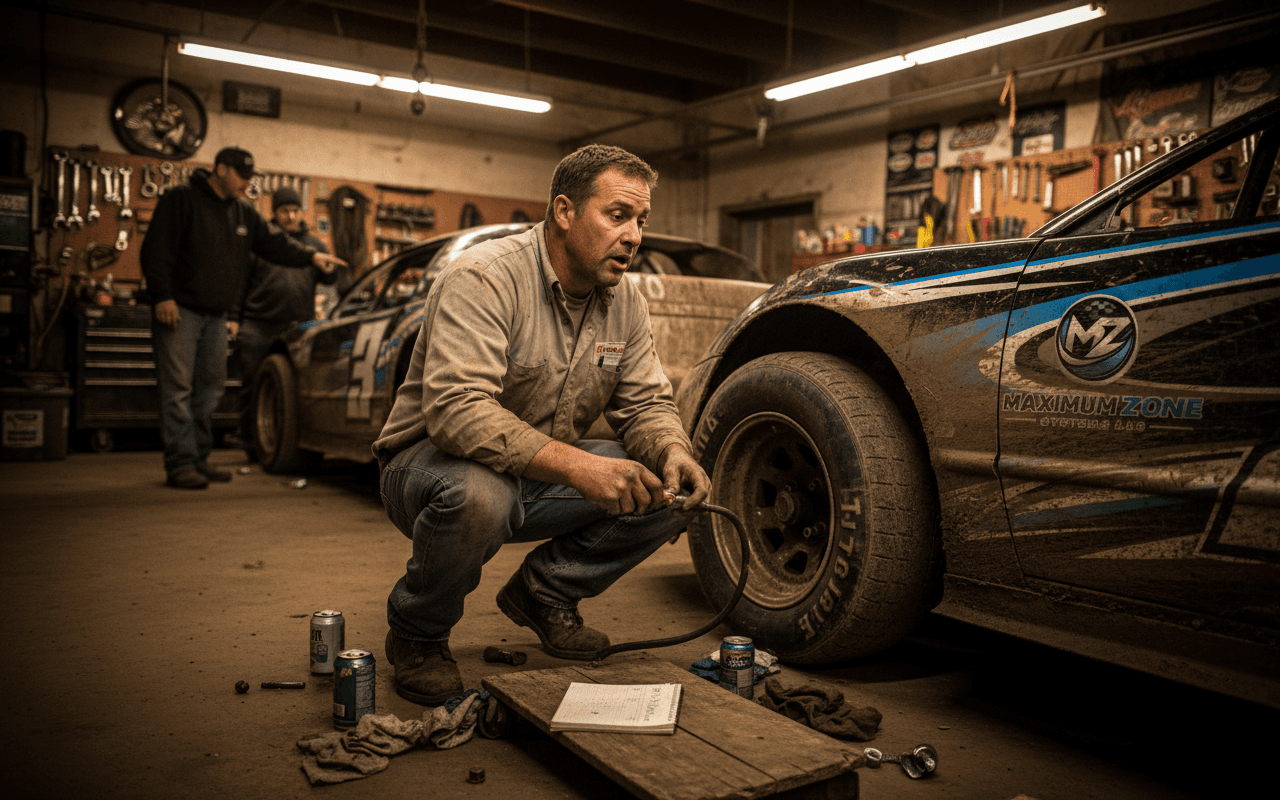
If you've spent any time in the pits on a Saturday night, you've heard the talk. 'I threw a 250 on the right front and it really woke the car up.' Or, 'Track got slick, so I dropped down to a 175 on the left rear.'
It sounds simple enough, but if you are newer to tuning a dirt car—or if you've just been blindly following a setup sheet you bought three years ago—spring rates can feel like black magic. You end up with a trailer wall covered in purple, blue, and silver coils, but no real idea when to bolt them on.
Let's fix that. No engineering degrees required. Just straight talk about dirt track spring rates, what the numbers actually mean, and how to use them to make your car faster on a Saturday night.
What is a Spring Rate? (Coil Spring Basics)
Let's start with coil spring basics. When we talk about a 'spring rate,' we are talking about the amount of weight (in pounds) it takes to compress that spring exactly one inch.
If you have a 200 lb spring, it takes 200 pounds of force to compress it one inch. To compress it two inches, it takes 400 pounds. To compress it three inches, it takes 600 pounds.
It's a linear math equation (assuming you are using standard linear springs, which 90% of local dirt racers are). The spring rate tells you how resistant the car is to moving. A stiffer spring resists weight transfer; a softer spring allows weight to transfer more easily.
In dirt racing, we use springs to control how the chassis rolls and pitches. When you hit the brakes, weight transfers forward. When you mash the gas, weight transfers rearward. When you pitch it into turn one, weight transfers to the right side. Your springs are the primary tool you have to control how fast and how far that weight moves.
How to Read a Racing Spring
Grab a spring off your rack. Wipe the mud off it. You'll usually see a set of numbers printed or etched into the flat part of the coil.
A common number format looks like this: 10-250 or 10250.
Here is what that means:
- 10 = The free length of the spring in inches (how tall it is sitting on the bench).
- 250 = The spring rate (250 lbs per inch).
Sometimes you'll see an inner diameter measurement too, like 5-10-250. That means it's a 5-inch outer diameter (standard for big springs), 10 inches tall, 250 lb rate. If you run coil-overs, you are likely looking at 2.5-inch or 1.9-inch inner diameter springs.
Pro Tip: Springs lose their rate over time, especially if they get hot or get run into coil bind. That 250-pound spring you bought off a guy on Facebook Marketplace might actually be a 220-pound spring now. If you are serious about your racing spring setup, invest in a spring smasher or make friends with a guy who has one. Test your springs at least twice a season and write the actual tested rate on them with a silver sharpie.
Spring Rate vs. Spring Load
This is where a lot of guys get lost. You need to understand the difference between rate and load.
- Rate is the stiffness of the spring (e.g., 200 lbs/inch).
- Load is the actual amount of weight the spring is holding up when the car is sitting at ride height.
Let's say your right front corner weighs 800 lbs. If you put a 200 lb spring in there, it will compress 4 inches to hold up that 800 lbs (200 x 4 = 800). If you put a 400 lb spring in there, it will only compress 2 inches to hold up that same 800 lbs (400 x 2 = 800).
In both scenarios, the load is exactly the same (800 lbs). But the rate is completely different. The 400 lb spring will make the right front feel stiff and punchy, while the 200 lb spring will let the nose dive deep into the corner. You tune with rate, but you scale the car with load.
A Quick Word on Preload
You can't talk about spring rates without mentioning preload. Preload is the tension you put on the spring before the car is set on the ground.
If you have a 10-inch, 200 lb spring, and you crank the coil-over nut down until the spring is 9 inches tall, you have added one inch of preload. The spring is already pushing back with 200 lbs of force. The suspension won't move until the track pushes up with more than 200 lbs of force. Preloading a softer spring is a popular way to keep the car at ride height while still allowing it to roll smoothly once you pitch it into the corner. Just ensure you don't compress it so far that the coils physically touch (coil bind), which instantly turns your suspension into a solid piece of steel and kills traction.
Front vs. Rear Balance in Dirt Racing
A dirt car is essentially two different machines bolted together: the front half, which gets you into the corner, and the rear half, which drives you out.
The Front Setup
Your front springs dictate your entry and mid-corner roll.
- Right Front (RF): This is usually the stiffest spring on the car. When you throw the car into the corner, all the weight wants to plant on the right front tire. A stiff RF spring holds the nose up, keeps the chassis from rolling over too far, and keeps the suspension geometry happy.
- Left Front (LF): This spring is usually softer. It helps plant the left side tires on deceleration and allows the left front wheel to droop and stay in contact with the track when the car rolls to the right.
The Rear Setup
Your rear springs are all about forward bite and traction.
- Right Rear (RR): This spring controls how much the right rear of the car squats under acceleration. A softer RR spring lets the car squat and bite, but if it's too soft, the car will roll completely over the right rear tire and break traction.
- Left Rear (LR): The LR spring is crucial for driving off the corner. When you get on the gas, weight transfers to the rear. The LR spring pushes the left rear tire into the dirt. A stiffer LR spring can actually drive more weight into the track on acceleration, increasing forward bite.
When to Go Stiffer with Your Springs
So, it's intermission. You just ran your heat race and the car didn't feel right. When should you reach for a stiffer spring?
1. The track is heavy, tacky, and fast. When there is a ton of grip in the dirt, the track is going to pull the car down hard. The g-forces are higher. If your springs are too soft, the car will roll too far, bottom out, or bind up the suspension. Stiffen up the right front and right rear to keep the car up on the bars.
2. The track is highly banked. High banking naturally compresses the suspension through the corners. You need stiffer springs to fight those compression forces and keep the chassis off the ground.
3. The car feels 'lazy' or unresponsive. If you turn the steering wheel and it feels like it takes a full second for the car to actually take a set and turn, your springs might be too soft. Stiffer springs make the car react faster to your inputs.
4. You are tight on corner entry. If the car pushes (plows) when you enter the corner, going to a stiffer right rear spring can help free the car up. It stops the rear from squatting so much, keeping weight on the front tires so they can steer.
When to Go Softer with Your Springs
Now, let's look at the opposite scenario. The track crew just watered, but it didn't hold. The track is black, slick, and offering zero grip.
1. The track is dry-slick. When there is no grip, a stiff car will just skate right across the top of the dust. You need to soften the car up. Softer springs allow the chassis to roll and transfer weight to the outside tires, physically pressing them down into the dirt to find traction.
2. The track is flat. Without banking to help you turn, you rely entirely on mechanical grip and weight transfer. Softer springs help the car roll and plant the outside tires on flat tracks.
3. The track is rough and rutted. If the track is full of holes, stiff springs will make the car bounce like a basketball. Every time the tire bounces off the ground, you lose traction. Softer springs absorb the bumps, keeping the tire contact patch glued to the dirt.
4. You are loose on corner exit. If the rear end is stepping out every time you touch the gas, try dropping the spring rate on the right rear. A softer right rear spring allows the car to squat and transfer weight onto the rear tires, giving you more forward bite to drive off the corner.
Keep Track of What Actually Works
Here is the hard truth: you can read all the setup guides in the world, but every chassis, driver, and local track is slightly different. What works for the guy parked next to you might make your car undrivable.
The only way to truly master your racing spring setup is to take detailed notes. Stop relying on your memory to recall what spring you ran on the left rear at this track three months ago.
This is where leveraging the race results tracking feature in your Maximum Zone Systems (MZS) account pays off. When you log your setup changes alongside your finishing position and lap times, you stop guessing. You start building a personal database of what spring combinations actually make your car faster in specific track conditions. It takes two minutes to log it on your phone before you load the car in the trailer, and it will save you hours of scratching your head next week.
The Bottom Line
Spring rates don't have to be complicated. Remember the golden rule: Stiff springs for heavy, fast, banked tracks. Soft springs for slick, flat, rough tracks.
Don't be afraid to make a change. The worst thing you can do is leave a bad setup in the car just because you are scared to unbolt a shock. Swap the spring, hit the track, and feel what the car does. That is how you learn, that is how you get faster, and that is how you end up parking it in victory lane on Saturday night.