Dirt Track Gear Ratio: How to Pick the Right Setup
Learn how to choose the perfect dirt track gear ratio for your car. Master RPM targets, quick-change gears, and final drive ratio to dominate Saturday night.
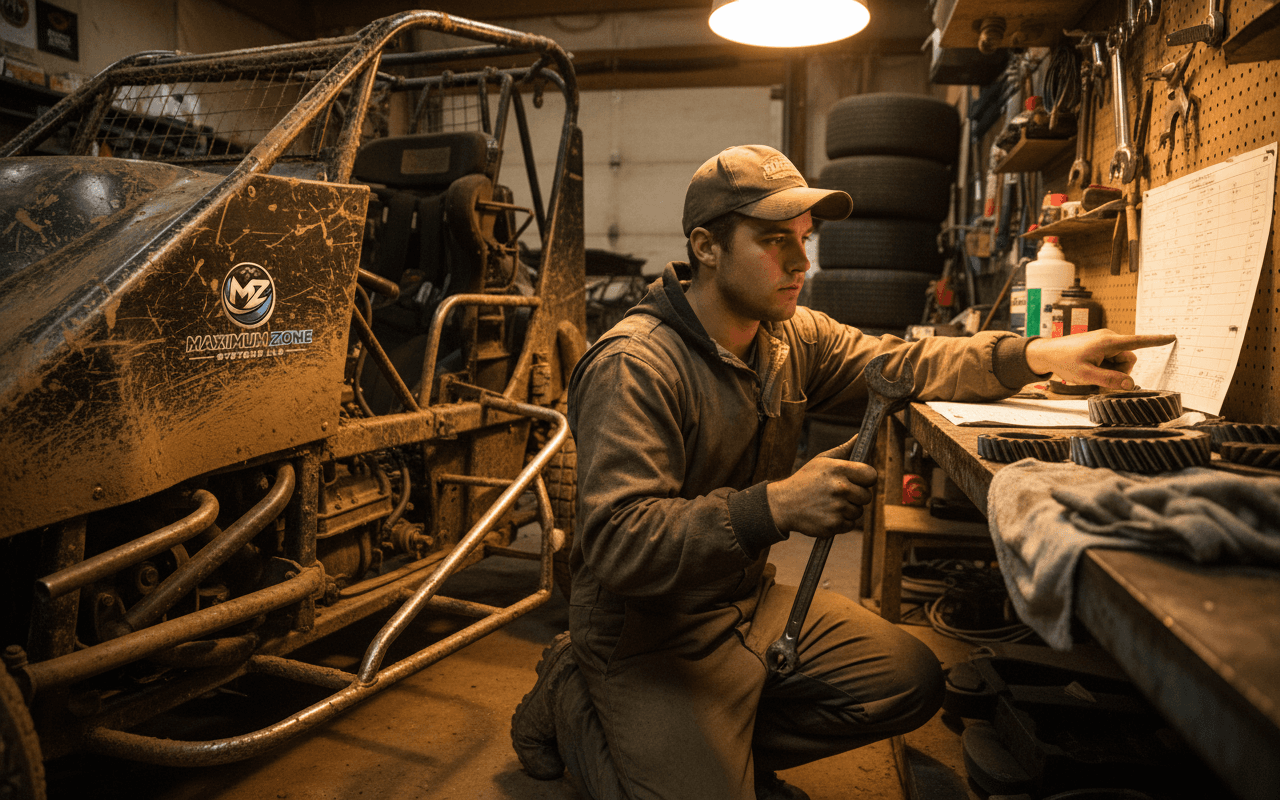
Let's talk about the single most critical adjustment you make before hot laps: your dirt track gear ratio. You can have the best shocks, a perfectly squared rear end, and a fresh motor, but if your gear is wrong, you're going to get passed on the straights or bogged down in the corners.
You've been there. You roll off the trailer, the track looks heavy, and you throw your standard gear in. But by the feature, the track has slicked off, your tires are spinning, and you're bouncing off the rev limiter. Gearing is not a "set it and forget it" deal. It requires constant adjustment based on track size, surface conditions, and your engine's power band.
Stop guessing your setup. Here is exactly how to nail your racing gear selection and find the sweet spot between pulling hard off the corner and not hitting the chip too early.
Understanding Your Final Drive Ratio
Before we get into track conditions, let's make sure the math is right. Your final drive ratio is the actual mechanical advantage your engine has over your rear tires.
If you run a quick-change rear end, your final drive isn't just the gear set you slide into the back. It's a combination of your ring and pinion and your quick-change gears.
Here is the formula: Ring and Pinion Ratio × Quick Change Gear Ratio = Final Drive Ratio
Most dirt track cars run either a 4.86 or a 4.11 ring and pinion. Let's say you have a 4.86 ring and pinion, and you drop in a #5 gear set (which has a ratio of 1.18).
- 4.86 × 1.18 = 5.73 Final Drive Ratio
A numerically higher number (like a 6.20) is a "lower" gear. It gives you more acceleration but less top speed. A numerically lower number (like a 5.40) is a "taller" gear. It gives you less acceleration but more top speed.
Don't Forget Tire Rollout
Your gear ratio doesn't stop at the axles. The circumference of your right rear tire—your rollout—acts as the final piece of the gearing puzzle.
A larger tire covers more ground per revolution, effectively giving you a taller gear. A smaller tire gives you a lower gear. If you normally run an 86-inch right rear and switch to an 88-inch right rear because the track got rough, you just changed your effective gear ratio.
- Pro Tip: Always measure your tire rollout with a stagger tape at your target tire pressure. If you change your tire size, you might need to drop or add a tooth in the rear end to compensate.
RPM Targets: Finding Your Engine's Happy Place
Your dirt track gear ratio really only has one job: keeping your engine in its optimal RPM range.
To do this right, you need to know two numbers from your engine builder (or your dyno sheet):
- Peak Torque RPM: This is where your engine pulls the hardest. You want to be at or slightly above this RPM in the center of the corner when you get back on the throttle.
- Peak Horsepower RPM: This is where your engine makes maximum power. You want to hit this RPM right at your lift point at the end of the straightaway.
Let's look at an example. If your engine makes peak torque at 5,000 RPM and peak horsepower at 7,200 RPM:
- If you gear the car so it drops to 4,200 RPM in the center of the corner, the car will feel lazy and take too long to accelerate. You need a lower gear (higher number) to pick the RPMs up.
- If you gear the car so it hits 7,200 RPM halfway down the straightaway, you are going to ride the rev limiter and lose top speed. You need a taller gear (lower number) to stretch it out.
Targeting the chip is a common mistake. You don't want to ride the chip for three car lengths entering the corner. You want to kiss the chip right as your right foot comes off the gas pedal.
Factoring in Track Size: 1/4 Mile vs. 1/2 Mile
The size and shape of the track dictate your baseline racing gear selection.
The 1/4 Mile Bullring
Short tracks are all about momentum and corner exit speed. You don't have long straightaways to build top speed, so acceleration is everything.
- The Strategy: You need a lower gear (higher numerical ratio, like a 5.80 to 6.20 depending on your class). This allows the engine to spool up instantly when you mash the gas off turn two.
- The Trap: Gearing too low on a short track can make the car twitchy and hard to drive. If the rear tires are constantly breaking traction, you aren't going forward.
The 1/2 Mile Momentum Track
Big tracks are about carrying speed and aerodynamics. You spend way more time at wide-open throttle.
- The Strategy: You need a taller gear (lower numerical ratio, like a 5.20 to 5.40). This keeps the engine pulling all the way down those massive straightaways without over-revving.
- The Trap: Gearing too tall will make the car a dog on restarts. You might get passed on the initial green flag before the car finally gets up to speed.
The Track Surface Curveball
If dirt tracks stayed the same all night, racing would be easy. But the surface changes drastically from hot laps to the A-Main, and your gear ratio needs to change with it.
Heavy, Tacky, and Fast
When the track has a lot of moisture, it creates immense mechanical grip. This grip pulls your engine RPM down.
- What to do: You usually need to run a lower gear (add gear) to keep the engine in its power band. The track can hold the aggressive power delivery without spinning the tires.
Dry, Slick, and Blacked Out
When the moisture leaves and the track takes rubber, your tires lose their mechanical grip.
- What to do: You need to take gear out (run a taller gear). Dropping your numerical ratio calms the engine down and reduces wheel spin. It makes the throttle less sensitive, allowing you to roll onto the gas smoother. Spinning tires don't win races. If you are blowing the tires off on a slick track, taking gear out is often the quickest fix.
The "Too Tight / Too Free" Trackside Test
Sometimes the math says one thing, but the car says another. Here is how to read what the chassis is telling you based on your gear selection.
The Car Feels "Too Tight" (Engine Bound)
If you are geared too tall (numerically low), the car will feel sluggish. But more importantly, it will handle poorly. We call this being "engine bound." The rear tires are pushing the front tires through the corner because the engine isn't revving fast enough to break traction and let the car rotate.
- The Fix: Put a lower gear in to free up the rear end.
The Car Feels "Too Free" (Snapping Loose)
If you are geared too low (numerically high), the car will snap loose on corner exit. The engine screams, but the car doesn't go anywhere. You are overpowering the available grip of the track.
- The Fix: Put a taller gear in to calm the rear end down and hook up the tires.
Tracking Your Gear Data
How do you remember what gear you ran at your local 3/8 mile track when it was dry slick in August versus heavy and tacky in May? Memory lies, and greasy notebook pages get lost in the trailer.
This is where smart teams get an edge. By logging your setup data alongside your race results tracking in MZS, you build a bulletproof personal playbook. Next time you roll up to the track and see the moisture level, you don't have to guess. You just pull up your MZS dashboard, look at what gear won you the heat race in similar conditions last year, and drop it in the rear end.
The Bottom Line
Picking the right dirt track gear ratio is a balancing act between your engine builder's dyno sheet, the length of the straightaway, and the moisture in the dirt.
Start with the math, listen to your engine's RPMs, and don't be afraid to pull the cover off the quick-change between the heat and the feature. The guys winning on Saturday night are the ones adapting to the track, not the ones hoping the track adapts to their setup. Get your gear right, keep the tires hooked up, and go park it in victory lane.