Dirt Track Tire Management: Maximize Every Set
Stop burning through tires. Learn practical dirt track tire management, from reading tire wear to rotation strategies and racing tire prep that saves you cash.
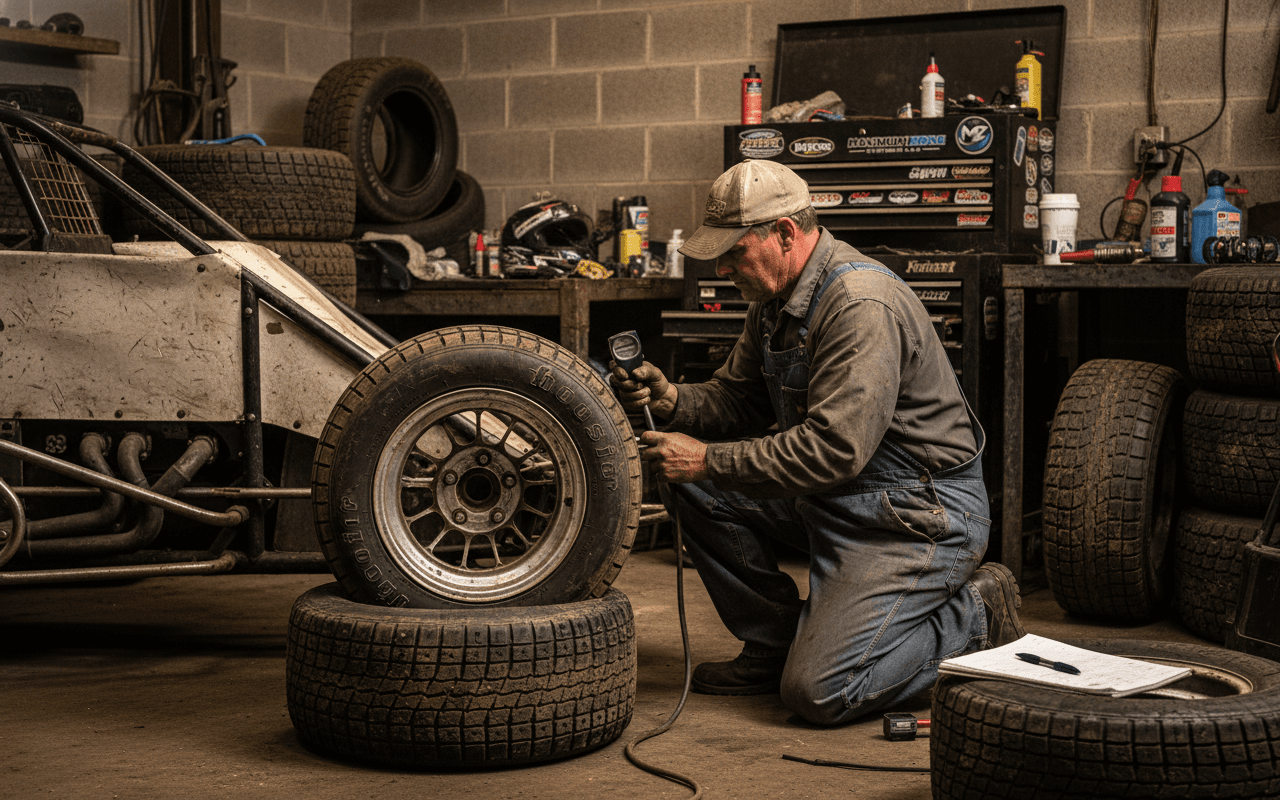
Tires are the single biggest ongoing expense in your racing budget. You can build a rocket ship in the garage, but if the four contact patches hitting the dirt are glazed, blistered, or the wrong stagger, you're going backwards on Saturday night. Dirt track tire management isn't just about buying new rubber; it's about stretching the life of the tires you already have without sacrificing speed.
Whether you're running a B-Mod on a dry-slick 1/4-mile or a Late Model on a heavy 1/2-mile, how you manage your tires across heats, features, and the entire season dictates your success. Let's break down how to get the absolute most out of every set.
Reading Tire Wear: Listen to Your Rubber
Your tires tell a story after every run. Learning to read tire wear dirt racing patterns will save you from making the same setup mistake twice. When you pull into the pits, immediately check your right rear.
- Graining: If your right rear looks like it's covered in little rubber pebbles or rolled-up eraser shavings, the tire is sliding too much across the surface rather than digging in. You're overheating the surface of the tire before the core gets up to temp. Check your cross-weight or consider softening your shock package to get more forward drive.
- Glazing: When the track goes dry-slick and your tire comes off looking shiny and feeling hard as a rock, it's glazed. You've essentially baked the oils out of the surface. You'll need to hit it with a grinder or sanding disc during the week to expose fresh rubber.
- Blistering: If you see chunks of rubber tearing out of the tread blocks, your tire got way too hot, way too fast. This usually happens on a heavy, tacky track when you're running too low of a tire pressure, or if you bolted on an overly soft compound for the track conditions.
Air Pressure: The Heat Cycle Game
Air pressure isn't a "set it and forget it" deal. Track conditions change drastically from hot laps to the A-Main, and your air pressure strategy needs to move with it.
- Cold vs. Hot Pressure: A tire starting at 8 psi in the pits might grow to 11 psi after 15 laps under green. You need to know your tire's growth rate. Check your hot pressures the second you pull off the track.
- Bleeders: If your class allows bleeders, use them. Set your right rear bleeder to your target hot pressure (let's say 10.5 psi). Start the tire at 9 psi cold. It allows the tire to build heat quickly and lock in right where you want it without over-inflating on a long green-flag run.
- Managing Stagger with Pressure: Air pressure isn't just about grip; it's about steering. Your rear stagger (the difference in circumference between your right rear and left rear) dictates how the car rotates. If the car is tight (pushing) in the center of the corner, adding a half-pound of air to the right rear increases its circumference, effectively increasing your stagger and helping the car turn. If you're loose, drop a half-pound to shrink the tire.
Racing Tire Prep: Grooving, Siping, and Chemicals
Every sanctioning body has different rules for racing tire prep, so rule number one is always: know your rulebook. Don't get disqualified over something stupid.
Grooving and Siping Cutting your tires is an art form. You are basically creating custom treads to match the dirt you are racing on.
- Siping: This means cutting razor-thin slits into the tread blocks. Siping allows the rubber to flex, which builds heat faster. It's perfect for hard-compound tires on a slick track. Sipe across the tire for forward bite, or around the circumference for side bite.
- Grooving: This involves removing strips of rubber to create distinct blocks. On a heavy, muddy track, you want wider grooves to evacuate mud and keep the tire from packing up.
Chemical Prep If your track allows chemical prep (and many local tracks don't, so double-check), the goal is to alter the durometer (hardness) of the tire.
- Internal Prep: Rolling the inside of the tire with chemicals alters the core of the rubber. It lasts longer and drops the durometer significantly.
- External Prep: Wiping the outside of the tire is a short-term fix. It might give you grip for an 8-lap heat race, but it usually burns off by lap 10 of a feature.
Rotation Strategies: Managing Your Inventory
You don't need to bolt on four sticker tires every week to be fast. Smart racers rotate their inventory to match the night's format.
- Heat Races: Heat races are short, and track conditions are usually heavier than feature time. This is a great time to run a slightly older, scrubbed tire. A tire with 40 laps on it can still be fast for 8-10 laps if the track has grip.
- The A-Main: Save your best rubber for the feature. When the track slicks off and you need to run 25 laps, you want the sharpest edges and the most consistent sidewalls on your right rear.
- The Left Rear Strategy: Your left rear tire is your drive tire off the corner on heavier tracks, but on a slick track, it's all about forward bite. Moving a slightly softer, scrubbed tire to the left rear can sometimes hook up better than a brand new sticker tire that hasn't been heat-cycled.
- Moving Tires Around: A right rear tire takes a beating. Once it loses its edge, don't throw it out. Depending on your tire rules, you can often remount it, flip it on the wheel, or move it to the front corners where the loads are drastically different.
Track Your Changes
Memory lies, but data doesn't. You might think you ran a 10 psi right rear on a slick track last August, but without notes, you're just guessing.
This is where keeping a tight log book pays off. By utilizing the race results tracking in MZS, you can log exactly which tire compounds, siping patterns, and air pressures you ran alongside your finish for the night. Next time you pull into that specific 3/8-mile oval and the track looks dry, you can pull up your history and know exactly which tire strategy put you in the top five.
Garage Maintenance: The Between-Race Hustle
How you treat your tires from Sunday to Friday determines how they perform on Saturday. Don't just toss your muddy wheels in the corner of the trailer and go drink a beer.
- Scrape and Wash: Get the mud off immediately. Mud pulls moisture and oils out of the rubber, drying it out. Wash your tires with simple soap and water. Avoid harsh degreasers that can chemically alter the rubber.
- Grind the Glaze: If you ran on a slick track, put your tires on a tire stand and hit them with a grinding disc or a wire wheel. You want to peel off that shiny, glazed layer to expose the fresh, porous rubber underneath. You should see a dull, matte black finish.
- Wrap Them Up: Air and UV light are the enemies of racing tires. Once they are clean and prepped for next week, wrap them in black shrink wrap or store them in heavy-duty tire bags.
- Winter Storage: When the season ends, don't leave your tires sitting on the concrete floor of your shop. Concrete draws moisture out of the rubber. Deflate them to about 5 psi, wrap them tight, and stack them on a wooden pallet or a tire rack out of direct sunlight.
The Bottom Line
Dirt track tire management isn't a dark art; it's a discipline. It requires you to pay attention to your wear patterns, stay on top of your air pressures, and put in the elbow grease during the week. Stop treating tires as a disposable expense and start treating them as a tunable suspension component. Maximize your rubber, and you'll maximize your racing budget.