J-Bar Deep Dive: Understanding the Most Sensitive Adjustment on Your Dirt Car
A complete breakdown of J-bar mechanics — roll center, rake angle, vertical force, and what actually happens when you move a hole. Frame side for entry, pinion side for exit.
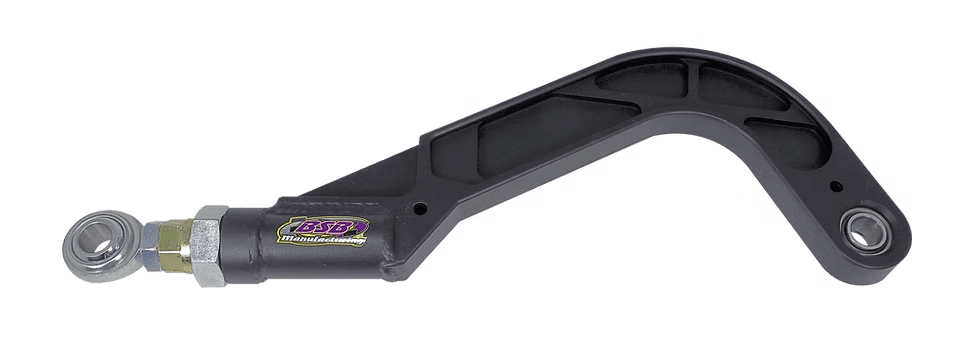
The J-bar might be the most powerful and most misunderstood tuning tool on a dirt car. It's just a bar with a rod end on each side — yet drivers can nearly always feel even a single-hole adjustment. Entire race nights hinge on getting it right. Even NASCAR crew chiefs treat 1/8" adjustments as career-defining calls.
This guide breaks down what the J-bar actually does, how each adjustment point affects the car, and when to move what. Whether you're on a modified or a late model, the physics are the same — only the magnitudes change.
What the J-Bar Actually Does
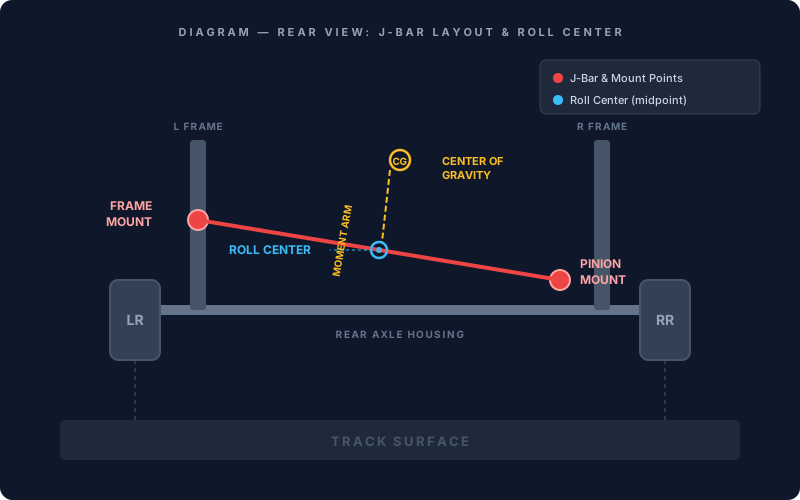
The J-bar (sometimes called a panhard bar) hooks to the left side of the frame rail and crosses the car in a "J" shape to connect near the pinion on the rear end housing. That J-shape exists purely for driveshaft clearance — the chassis only knows it as a straight line between the two mounting points. The shape of the bar doesn't affect its function at all.
The bar has one primary structural purpose: it locates the rear axle laterally — keeping the rear end from moving side to side. But in doing that simple job, it controls two critical handling variables simultaneously.
Job 1: Rear Roll Center Height
The rear roll center of a panhard bar system is located directly at the midpoint of an imaginary straight line drawn between the two mounting heims. The roll center dictates how the chassis rolls relative to the center of gravity. A higher roll center sits closer to the CG, meaning the CG has less leverage — less body roll and more direct weight transfer to the outside tire. A lower roll center creates more distance from the CG, allowing more roll and slower, more progressive weight transfer.
Job 2: Rake Angle and Vertical Force
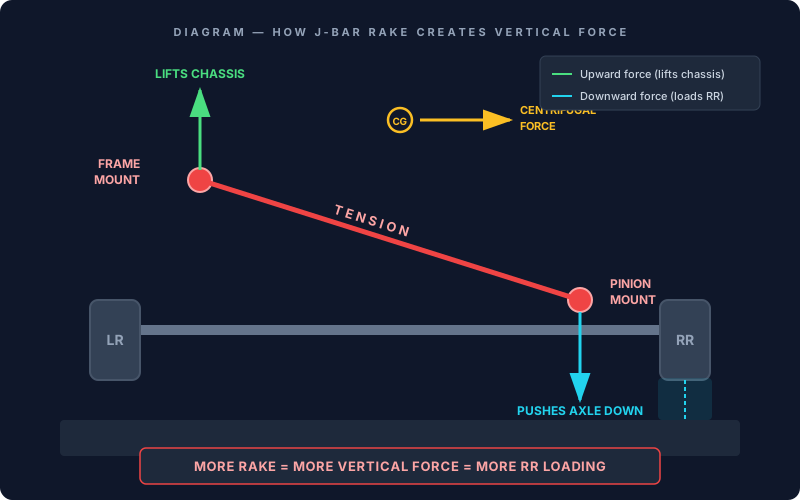
When the J-bar is angled (one mount higher than the other), something interesting happens. The lateral force coming through the bar during cornering splits into two components: a horizontal force that locates the axle, and a vertical force that physically pushes down on the axle where the bar connects. Because the pinion mount sits to the right of the axle's centerline on most dirt cars, that downward force loads the right rear tire preferentially. More rake angle means more vertical force, which means more mechanical grip being driven into the track surface.
The mechanism most racers miss: It's not just about roll center — the J-bar is literally pushing your right rear tire into the dirt through leverage. More rake angle = more vertical force = more side bite.
The Vertical Force Mechanism
When the J-bar is perfectly level, 100% of the lateral grip from the rear tires transfers into the chassis horizontally. But the moment you angle the bar — which is always the case on a dirt car — the force splits into horizontal and vertical components. The steeper the angle, the larger the vertical component.
At the frame mount (left side), that vertical component pushes up on the chassis. At the pinion mount (right side), an equal and opposite force pushes down on the axle. Because the pinion mount sits to the right of the axle centerline, that downward force loads the right rear tire more than the left rear. This is your side bite — mechanical leverage physically driving the tire into the track surface.
The Six Adjustment Scenarios
There are six fundamental moves you can make with the J-bar, and each one produces a different combination of roll center change and rake angle change. Understanding these is the difference between chasing your setup all night and making one smart adjustment between the heat and the feature.
Quick Reference
| Mount | Direction | Primary Effect |
|---|---|---|
| Frame Side | Up | Tighter entry — RC higher, more rake |
| Frame Side | Down | Looser entry — RC lower, less rake |
| Pinion Side | Down | Tighter exit — more bite off corner |
| Pinion Side | Up | Looser exit — less bite, freer off |
| Both | Up equally | Less overall roll, quicker response |
| Both | Down equally | More overall roll, softer response |
The Rule: Frame side for entry. Pinion side for exit. Both together for overall roll rate.
Breaking Down Each Scenario
Raise Frame Side Only — Tighten Entry
This is one of the most common and effective J-bar adjustments on dirt. Raising the frame mount does two things simultaneously: it raises the overall roll center height (less roll, more direct weight transfer) and increases the rake angle (more vertical force pushing the LR into the track). The car resists rolling on entry and takes a harder set. If you're loose getting into the corner, this is often the first move to try.
Lower Frame Side Only — Loosen Entry
If you're at a tight-in track and can't carry speed into the corner, lowering the J-bar on the frame frees the entry. You're lowering the RC, increasing the moment arm to the CG, and reducing rake angle — all of which let the chassis roll more freely on entry. The rear end will step out and rotate before loading the right rear.
Key distinction: this is a rear tire adjustment, not a front tire one. If the car doesn't turn at all, you might still need a front-end change.
Lower Pinion Side Only — Tighten Exit
This one is counterintuitive. Dropping the pinion side lowers the overall RC (which usually means more roll), but it increases the rake angle because the differential between the two mounts grows. The car gets up on the bar more quickly under acceleration, shifting weight to the right rear sooner. The result is more forward bite coming off the corner. If you're spinning the tires on exit, dropping a hole on the pinion is worth trying.
Raise Pinion Side Only — Loosen Exit
Reduces rake angle while raising the RC. The vertical force component diminishes, meaning less downward loading through the bar under power. The car will be freer driving off the corner. Be careful with this one — on a dry-slick surface where you're already spinning the tires, raising the pinion makes it worse.
Raise Both Equally — Less Roll, Quicker Response
The rake angle stays the same, so the vertical force balance doesn't change. But the higher roll center means the CG has less leverage, so the car rolls less and transfers weight more directly. This is your heavy, tacky track move. When there's tons of grip available and you need the car to respond crisply, raise both mounts equally.
Lower Both Equally — More Roll, Softer Response
Rake stays the same, but the lower RC creates more roll freedom. The car becomes more forgiving — it takes longer to transition and weight transfer happens more progressively. This is ideal when the track is slicking off through the night and you need to smooth things out. At a bumpy, worn-out small track with little banking, a lower overall J-bar position helps the car absorb imperfections rather than reacting violently to them.
The too-much-rake trap: In theory, increasing rake should tighten the car any time it's up on the bar. But too much angle can stop the chassis from rolling entirely. When that happens, the car pushes because the front end has nothing to work against — you've over-tightened the rear without gaining anything at the front. If the car feels planted but won't rotate, you've gone too far with the rake.
Starting Points
Every car is different and every chassis builder will have specific recommendations for their platform. That said, here are some commonly referenced baselines for dirt cars:
Modified with Crate Motor (~54% Left Side Weight)
- Pinion mount: 1" to 1.5" above pinion center on a quick-change; center to 3/4" above on a 9" Ford
- Frame mount: Approximately 6" split from pinion height — typically 8-9" from bottom of frame to center of heim
Modified vs. Late Model Considerations
On a modified, the J-bar is typically shorter due to narrower chassis width. Shorter panhard bars translate the rear end more with suspension travel, which means each mount-height adjustment has a more exaggerated effect. A half-hole change on a modified's J-bar can feel like a full hole on a late model.
Late models, with their wider rear track and longer bars, tend to be more forgiving with absolute J-bar height adjustments but more sensitive to rake angle because the longer bar amplifies the vertical force component over a wider arc.
Regardless of the platform, the fundamental rule holds: the J-bar is the single most sensitive adjustment on the rear of your dirt car. Understanding which mount to move and why is the difference between chasing the setup all night and making one smart adjustment that puts you in victory lane.
Remember: The shape of the J-bar does not change how it loads the rear tires. It is a point-A to point-B device. The design determines how much load is on the rod ends and how fast they wear — but handling-wise, it's all about the two mounting points.
Sources & Further Reading
- JOES Racing Products — "Panhard Bar & J-Bar" — joesracing.com
- Get Started Racing — "Panhard Bars and Handling" — getstartedracing.com
- Old School Racing — "Understanding the Dirt Late Model" — osracing.net
- BSB Manufacturing — "J Bars" (Billy Moyer Jr. Tech Talk) — bsbgofast.com
- OneDirt — "Tech Made Simple: The J-Bar As Explained By Billy Moyer Jr." — onedirt.com
- Hyper Racing — "Rethink Dirt: Advanced Dirt Track Theory" — hyperracing.com
- Harris Auto Racing — "2016+ Chassis Manual" — harrisautoracing.com
- 4m.net Racing Forum — "J-Bar Explanation" and "Rear Panhard Bar Tech" threads
- iRacing — "Commodore's Garage #10: Track Bar" — iracing.com
- RaceKnowHow — "Modified Panhard Bar/J-Bar Adjustments with Jason Wilkey" — raceknowhow.com