Racing Fuel Management: The Ultimate Dirt Track Fuel Strategy
Master your dirt track fuel strategy with actionable tips on race fuel freshness, storage, methanol vs gas, and system maintenance to prevent Saturday DNF's.
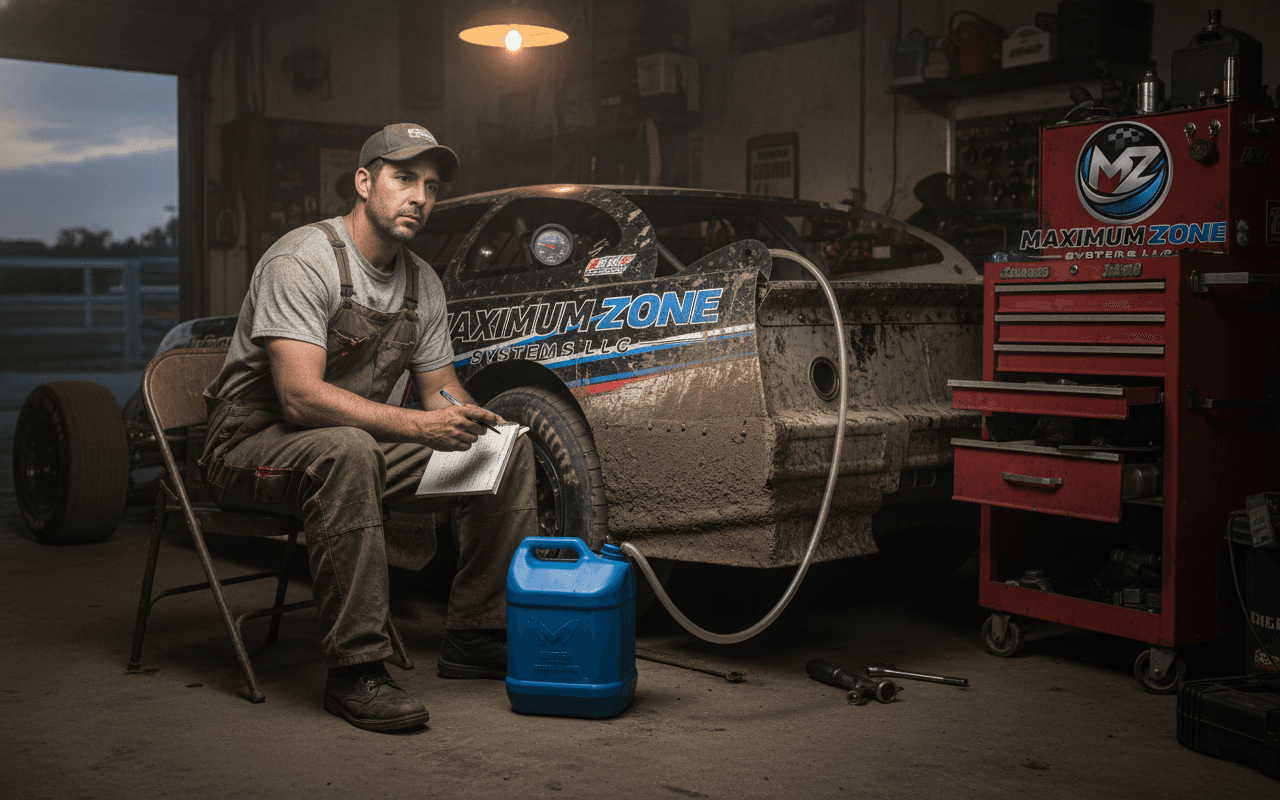
Racing Fuel Management: The Ultimate Dirt Track Fuel Strategy
That heavy, sinking feeling when your engine sputters coming out of Turn 4 on the white flag lap—there is absolutely nothing worse. Running out of fuel under a late-race caution is a heartbreaker, but carrying too much fuel means you are lugging around a heavy anchor in the tail tank.
Mastering your racing fuel management is about finding that perfect balance. It is a critical piece of your overall dirt track fuel strategy. You want to cross the scales after the feature light enough to win, but wet enough to actually finish.
Whether you are running a Street Stock on pump gas, a Modified on racing gas, or a Late Model or Sprint Car on pure methanol, fuel is not just a liquid you dump in the tank. It is a performance part.
Here is exactly how to manage your race fuel from the 55-gallon drum in your shop to the checkered flag on Saturday night.
Methanol vs. Gasoline: The Basics
Before we talk strategy, we need to talk chemistry. The fuel you run dictates your entire fuel system setup and maintenance routine.
Racing Gasoline:
- Energy dense: Gas packs a lot of energy per gallon. You burn less of it, which means you can run a smaller, lighter fuel cell.
- Forgiving: Gas is relatively stable. It doesn't attract water like a magnet, and it won't corrode your fuel lines if you let it sit for a week.
- Hotter: Gas burns hotter than methanol, meaning your engine cooling system needs to be perfectly dialed in for those slick, hot summer nights.
Methanol (Alcohol):
- High volume: Methanol has a much lower stoichiometric ratio than gas. You have to burn roughly twice as much methanol to make the same power. This means larger lines, a bigger mechanical fuel pump, and a massive fuel cell.
- Cooling effect: Methanol pulls heat out of the intake charge. Engines run significantly cooler, which is a massive advantage on a dirt track.
- Corrosive and thirsty: Methanol is highly corrosive to bare aluminum and certain rubbers. It is also hygroscopic, meaning it actively pulls moisture out of the air.
The Weight Game: How Much Fuel to Carry
Fuel weight is dynamic. Methanol weighs about 6.6 pounds per gallon, and racing gas weighs about 6 pounds per gallon. If you dump 30 gallons into your cell, you are strapping nearly 200 pounds of dead weight high and behind the rear axle.
As the race goes on, that weight burns off, fundamentally changing your car's handling. If you carry 10 gallons more than you need, you are giving up 60+ pounds of performance to the guy next to you.
So, how do you calculate your exact fuel load? Stop guessing and start doing the math.
Step 1: Calculate your green-flag burn rate. Fill your tank to a known, exact level before your hot laps or heat race. Run your session. Immediately refill the tank using a graduated jug to see exactly how much you burned. Divide that by the number of laps. Example: You burned 4 gallons in an 8-lap heat race. Your burn rate is 0.5 gallons per green-flag lap.
Step 2: Calculate your caution burn rate. Engines burn significantly less fuel under caution, but they still burn fuel. A good rule of thumb is that caution laps burn about 25% to 30% of a green flag lap. Example: 0.5 gallons x 0.30 = 0.15 gallons per caution lap.
Step 3: Do the feature math. For a 25-lap feature on a typical 3/8-mile track, calculate your base need, then add your safety buffer.
- Green Laps: 25 laps x 0.5 gal = 12.5 gallons
- Pace Laps: 3 laps x 0.15 gal = 0.45 gallons
- Estimated Cautions: Plan for a worst-case scenario. Let's say 15 caution laps. 15 laps x 0.15 gal = 2.25 gallons
- Total Expected Burn: 15.2 gallons.
Step 4: Add the pickup buffer. Your fuel pickup needs a minimum amount of fuel to prevent sucking air in the corners. Depending on your cell design and foam condition, this is usually 2 to 3 gallons.
- Final Load: 15.2 + 3 = 18.2 gallons. Round up to 19 gallons to be safe.
Do not just dump two 5-gallon jugs in and hope for the best. Know your numbers.
Fuel Freshness and Proper Storage
Your race fuel is only as good as the conditions you store it in. Bad fuel costs horsepower, causes stumbles on restarts, and can even melt down an engine if it causes a lean condition.
Keep it Sealed This is especially critical for methanol. Because it is hygroscopic, an open bung on a 55-gallon drum in a humid garage will ruin the fuel in a matter of days. As it absorbs water, the fuel turns milky, loses its combustibility, and wreaks havoc on your engine. Always tighten the bungs immediately after pumping.
Store Drums off the Concrete Concrete floors fluctuate in temperature and hold moisture. Placing your steel fuel drums directly on the concrete can cause condensation inside the drum. Put your drums on a wooden pallet or a dedicated drum dolly to create an air gap.
Test Your Fuel Don't blindly trust what is in the drum, especially if it has been sitting for a few weeks. Buy a simple fuel hydrometer. This tool measures the specific gravity of the fuel. If the specific gravity changes drastically from when you first bought the drum, the fuel has degraded or absorbed water.
Filter on the Way In Never pump fuel directly from the drum into your car's fuel cell without passing it through a filter. Small metal shavings from the drum threads, dirt from the shop air, or degraded plastic from jugs can easily find their way into your tank. Use a high-quality funnel with a built-in micro-mesh filter.
Fuel System Maintenance: Preventing Saturday Night Failures
A strong dirt track fuel strategy doesn't end when the car goes back in the trailer. What you do in the shop during the week dictates whether you finish the race on Saturday.
If you run methanol, your post-race maintenance is non-negotiable. If you leave methanol sitting in your fuel system all week, it will dry out your O-rings, corrode your aluminum fittings, and leave a chalky white residue inside your carburetor or injection system.
The Weekly Flush (Pickling the System):
- Drain the Cell: After the race, drain all remaining methanol out of the fuel cell. Do not leave it in the car all week.
- Run it Dry: Start the engine and let it idle until it completely runs out of methanol and dies.
- Introduce Gasoline/Lubricant: Plumb a small remote tank filled with racing gas (or a specific flushing fluid mixed with top lube) directly to your fuel pump inlet.
- Flush the Lines: Start the engine on the flush mixture and let it run for a minute. This coats the inside of the mechanical pump, the bypass valves, and the injectors/carburetor with a protective layer of lubrication.
- Cap the Vents: Cap off the fuel cell vent to prevent moisture from entering the empty cell during the week.
Inspect Your Filters and Cell Foam At least once a month, pull your inline fuel filters apart. Don't just look at them—clean them with brake cleaner and back-blow them with compressed air.
Additionally, check the foam inside your fuel cell twice a season. Fuel cell foam breaks down over time, turning into a sludgy mess that will clog your pickup tube and cause a lean-out condition under acceleration. If the foam feels crunchy or crumbles when you pinch it, replace it immediately.
Tracking Your Barrels in the Shop
We have all been there. It is Thursday night, you are thrashing to get the car scaled and loaded, and you go to pump fuel into your jugs—only to realize the drum is basically empty. Now you are frantically texting buddies or paying a premium at the track on race day.
Managing your shop stock is just as important as managing the fuel in your car. This is where keeping track of your consumables saves you massive headaches. If you use the inventory management tools in Maximum Zone Systems (MZS), you can track your fuel drums right alongside your tires, tear-offs, and spare suspension parts. It takes two seconds to log what you pumped out after the race, so you know exactly when to order your next drum before the panic sets in. No spreadsheets, no guessing—just peace of mind.
The Final Lap
Your fuel system is the lifeblood of your race car. Treat your racing fuel management with the same precision that you apply to your stagger, your tire pressures, and your shock package.
Calculate your exact fuel load so you aren't carrying unnecessary weight. Keep your methanol sealed tight and off the concrete. Flush your system religiously every single week.
Do the math, maintain the system, and keep your fuel clean. That is how you guarantee your engine pulls hard all the way to the checkered flag, leaving the competition sputtering in your dust.