How to Build a Dirt Track Racing Budget That Actually Works
Stop guessing what your racing season costs. Get a realistic breakdown of tires, fuel, entry fees, and parts to build a dirt track racing budget that works.
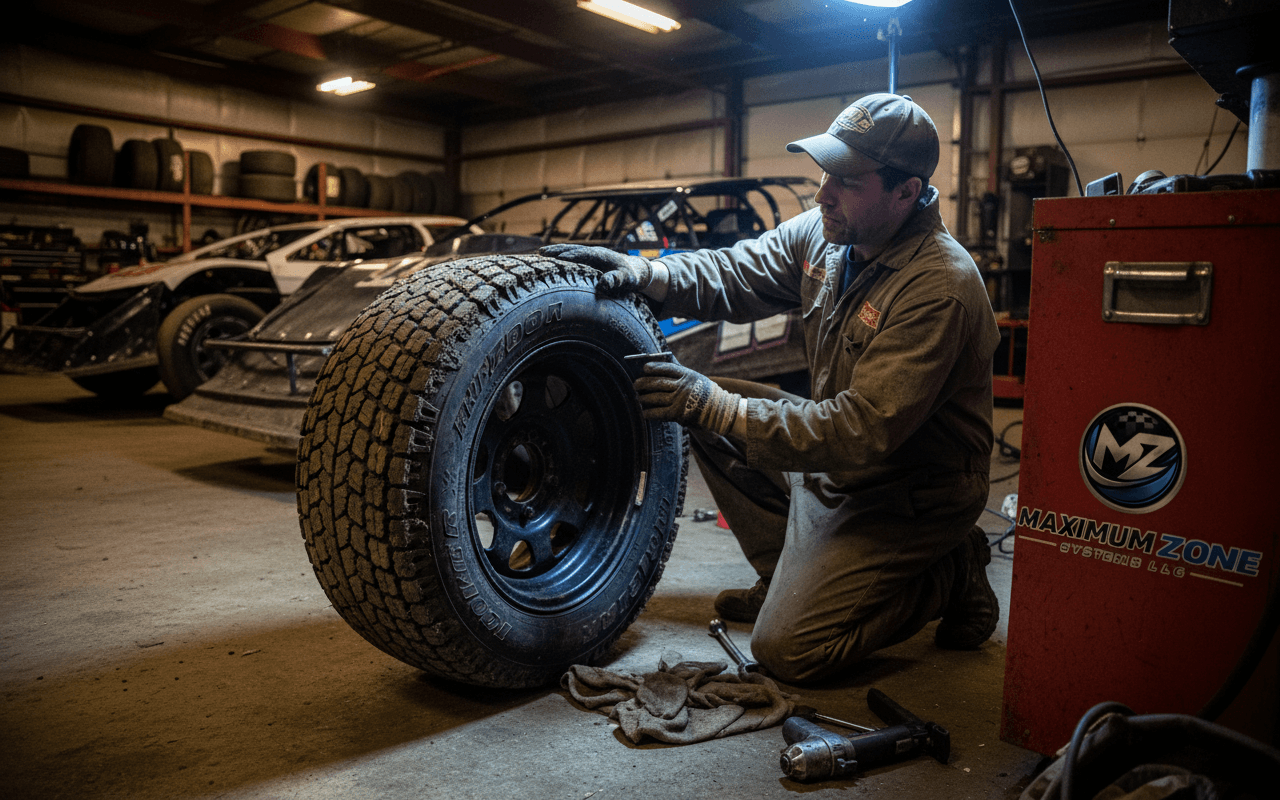
If you are reading this, you already know the drill. It's Thursday night, you're covered in grease, and you're staring at a right rear tire trying to decide if it has one more feature event left in it. You race because you love it. But let's be brutally honest: passion doesn't pay the parts bill. If you want to run a full dirt track racing season without draining your personal savings or parking the car by July, you need a rock-solid racing budget.
Most local racers run on a week-to-week basis. They take whatever is left in their paycheck, buy some race gas, and hope they don't tear up the front clip. But if you want to compete for a championship at your local 1/4-mile or 1/2-mile oval, you need to treat your race team like a business.
Here is your practical, no-BS guide to budgeting a full dirt track season, from the off-season rebuild to the final checkered flag.
The Off-Season: Where the Budget Actually Starts
Your season budget doesn't start on opening night. It starts in November. The off-season is when the big checks are written, and if you don't budget for this, your in-season numbers will be completely skewed.
- Engine Refresh: Depending on your class, this is your biggest hit. A basic crate engine refresh (like a 602 or 604) might run you $1,500 to $3,000. An open motor for a Late Model or Modified? You are looking at $5,000 to $15,000+.
- Chassis Updates: Are you putting a new clip on? Sending the chassis out to be squared? Budget $1,000 to $3,000 for off-season chassis maintenance.
- Shocks: Dirt track racing is all about traction, and your shocks do the heavy lifting. Rebuilding and dynoing a four-corner set of racing shocks will cost between $400 and $800. Do not skip this.
- Safety Gear: Check the expiration dates on your belts, window nets, and helmet. A new set of high-quality belts is around $150 to $200.
Action Step: Calculate your total off-season rebuild cost. Divide that number by the number of races you plan to run. If your rebuild costs $4,000 and you plan to run 20 races, you need to add $200 per race to your true operating cost.
The Fixed Costs: The Price of Showing Up
Before your car even rolls out of the trailer, you are spending money. These are your fixed dirt track costs—the numbers that do not change regardless of how well you run.
- Hauler Fuel: Do the math. If the track is 45 miles away, that is a 90-mile round trip. If your rig gets 8 miles to the gallon, you are burning about 11 gallons of diesel. At $4.00 a gallon, that is $44 just to get there and back.
- Pit Passes: You cannot race by yourself. You need at least one or two guys to help with tire pressures, mud scraping, and hot lap adjustments. If pit passes are $35, and you are paying for yourself and two crew members, that is $105 per night.
- Entry Fees: Many weekly shows wave the car entry fee, but special events or traveling series will hit you for $50 to $100 right at the pill draw.
- Crew Meals: Your crew works for free, so the least you can do is feed them. A cooler full of sports drinks, water, and a run to the burger stand will cost you $40 to $60 a night.
Weekly Fixed Budget: Plan for $150 to $250 per night before you even fire the engine.
The Consumables: Tires and Fuel
This is where your weekly budget lives or dies. Consumables are the lifeblood of a dirt track car.
- Race Fuel: Are you running on methanol or race gas? A typical A-Mod or Late Model burning methanol might use 15 to 20 gallons a night. At $5 a gallon, that is $75 to $100. If you are running 110-octane race gas in a Street Stock, you might burn 10 gallons at $12 a gallon, which puts you at $120.
- Tires: This is the ultimate budget killer. A new dirt tire costs anywhere from $160 to $200+. If your track mandates a specific compound, you might be buying a new right rear every single week. If you are in a budget class, you might get three weeks out of a right rear and half a season out of a left front.
- Tire Prep: Don't forget the cost of grooving blades, siping tools, and tire prep chemicals (if your track allows them). Budget $20 a week for prep supplies.
Weekly Consumables Budget: Depending on your class, expect to spend $150 to $400 every single week on fuel and rubber.
Maintenance: Keeping the Bullet Alive
Dirt track racing destroys parts. The vibration, the mud, and the track conditions wear out components faster than any other motorsport.
- Oil and Filters: You should be changing your racing oil every 3 to 5 nights. At $10 a quart for high-zinc racing oil plus a premium filter, an oil change is an $80 to $100 expense. That breaks down to about $20 per race.
- Tear-Offs: A pack of tear-offs is about $25. You will use a few every night.
- Wash Supplies: Mud is heavy and holds moisture. Pressure washing your car requires fuel for the washer, heavy-duty degreasers, and lubricants like WD-40 to spray down your rod ends. Budget $15 a week.
- Rod Ends and Bearings: You should be replacing worn rod ends (heim joints) before they snap and send you into the concrete. Budget $30 a week in preventative hardware replacement.
The "Oh Crap" Fund: Crash Damage
If you race dirt, you are going to bend things. It is not a matter of if, but when. Someone is going to slide up in front of you in turn two, or you are going to jump the cushion and kiss the wall.
Do not let a bent spindle end your season. You need an "Oh Crap" fund built into your budget.
- Front End Parts: Tie rods, spindles, upper control arms, and ball joints take a beating.
- Bodywork: Sheet metal, plastic nose pieces, and rub rails get destroyed regularly.
- Bumpers: You will bend rear bumpers. Keep a spare in the trailer.
Rule of Thumb: Take your total weekly running cost and add 25%. Put that 25% into a separate envelope or bank account. When you inevitably knock the front end off the car, you will have the cash to buy the parts on Monday morning.
Realistic Cost Breakdowns by Class
To give you a clear picture, here is what a typical Saturday night costs at a local short track, depending on your division. (These numbers do not include off-season rebuilds or major crash damage).
Budget Tier (Hornets, Bombers, Pure Stocks)
- Tires: $50 (using pull-offs or making them last a month)
- Fuel: $40 (pump gas or minimal race gas)
- Fixed Costs (Pit passes, travel): $100
- Total: $190 per night
Mid-Level Tier (Street Stocks, B-Mods, Sport Mods)
- Tires: $180 (one new tire a week)
- Fuel: $100
- Fixed Costs: $150
- Total: $430 per night
Top Tier (A-Mods, Late Models, 360 Sprints)
- Tires: $350+ (two new tires a week)
- Fuel: $120
- Fixed Costs: $200
- Total: $670+ per night
How to Actually Track This Mess
Here is the cold, hard truth: guessing your budget does not work. If you are still stuffing greasy parts receipts into a shoebox or trying to remember what you spent on methanol three weeks ago, you are setting yourself up for failure.
When you don't track your numbers, you run out of money halfway through August.
This is where using a tool built specifically for racers makes a massive difference. The expense tracking feature in Maximum Zone Systems (MZS) lets you log those tire purchases, fuel receipts, and pit passes right from your phone while you are still sitting in the staging area. You instantly see exactly where your season budget is heading. Having these hard numbers in your pocket makes it a hundred times easier to tell potential sponsors exactly what you need to keep the car competitive.
Making the Budget Work: Purses vs. Reality
One of the biggest mistakes rookie racers make is budgeting based on purse money.
Do not rely on your winnings to get you to the next race.
If you are running a B-Mod and it costs you $400 to race, but the feature only pays $500 to win and $75 to start, the math is working against you. If you blow a tire in your heat race and miss the feature, you still spent the $400, but you brought home zero.
- Treat purse money as a bonus: Use your winnings to fund your "Oh Crap" account or buy upgrade parts.
- Use sponsorships to cover consumables: When pitching local businesses, don't just ask for $1,000. Ask them to cover your tire bill for the month. Tell them, "It costs me $180 a week in tires to run up front. For $720, you can be my primary tire sponsor for the next month, and I'll put your logo on the quarter panel."
The Final Takeaway
Budgeting a full dirt track season isn't as glamorous as pulling a slide job for the win, but it is exactly what makes that win possible. Know your fixed costs, manage your consumables, build a crash fund, and track every single dollar.
The guys who win championships aren't always the ones with the most money—they are the ones who manage their money the best. Get your numbers dialed in this week, and we'll see you at the track on Saturday night.